

Trump lands in Abu Dhabi with AI, investment and historic US-UAE relations in focus
Talks cover semiconductors, space, nuclear energy and artificial intelligence development on agenda
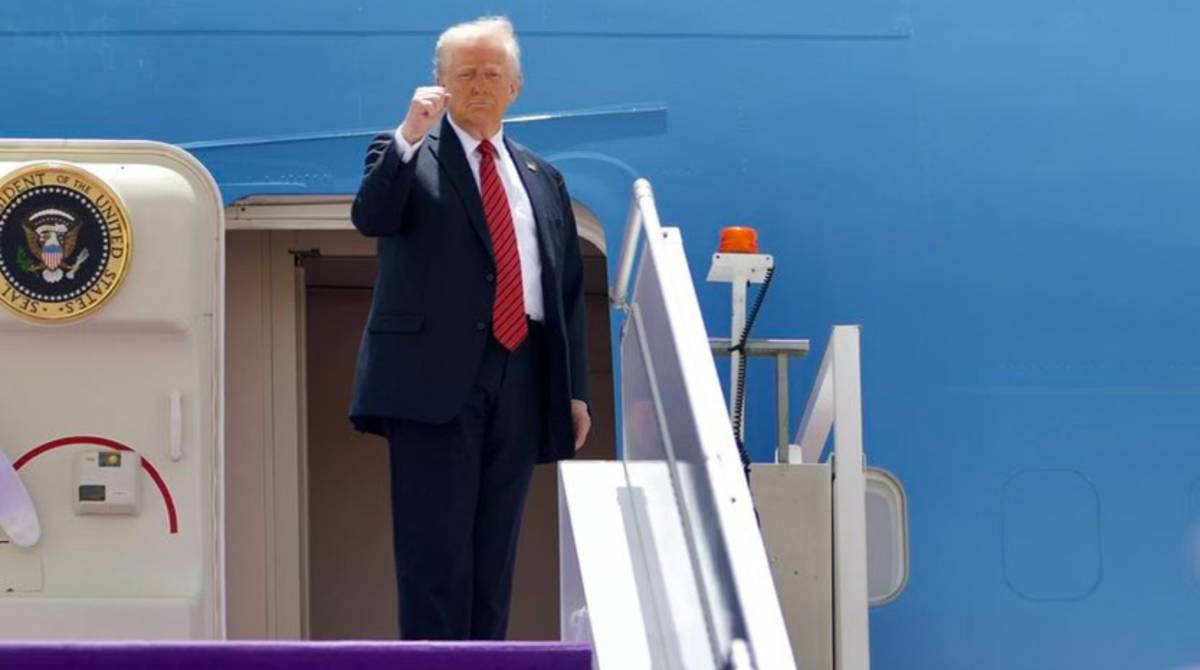
ABU DHABI: US President Donald Trump has arrived in the United Arab Emirates (UAE) as part of his four-day tour of the Gulf that has already yielded major diplomatic and economic outcomes.
His final stop follows visits to Saudi Arabia and Qatar, where he signed multibillion-dollar deals and made a surprise announcement lifting US sanctions on Syria.
Before heading to UAE, Trump addressed American troops stationed at Qatar's Al Udeid Air Base southwest of Doha before flying to Abu Dhabi later this morning.
His visit to the UAE marks only the second time a sitting US president has visited the Gulf nation, following President George W. Bush’s trip in 2008.
UAE President welcomes US President Trump upon arrival in Abu Dhabi on state visit to UAE#UAE_welcomes_US_President#UAEUSA #WamNews https://t.co/xIieOO4koa pic.twitter.com/zelME5mPCp
— WAM English (@WAMNEWS_ENG) May 15, 2025
Trump in UAE
The UAE leg of the tour is expected to focus heavily on artificial intelligence, energy, and defence cooperation. Trump will meet with President His Highness Sheikh Mohamed bin Zayed Al Nahyan and senior Emirati officials in Abu Dhabi to discuss strategic investments in semiconductors, AI, manufacturing, and clean energy.
Reuters reports that the United States has entered into a preliminary agreement allowing the UAE to import 500,000 of Nvidia’s most advanced AI chips annually, starting this year. The chips are vital to building next-generation data centres and advancing large-scale AI models.
The visit coincides with growing cooperation between the two countries across several sectors. The UAE is already the United States’ largest trading partner in the Middle East and North Africa, and bilateral trade remains strong, with non-oil commerce reaching $32.8 billion in 2024.
AI and innovation
President Trump’s UAE visit underscores the nations’ shared vision to lead in artificial intelligence. Several recent agreements have further accelerated US-UAE AI collaboration. In April 2024, Microsoft announced a $1.5 billion investment in G42, the UAE’s AI holding group.
This was followed in June by a deal between US-based World Wide Technology and UAE’s NXT-Global to create the first AI integration centre in Masdar City. By September, both countries had formalised a broader framework for AI cooperation.
One of the most ambitious ventures, the “AI Infrastructure Partnership,” involves Microsoft, BlackRock, UAE-based MGX, and Elon Musk’s xAI, aiming to mobilise up to $100 billion in capital to build global AI infrastructure. The initiative is projected to generate 20,000 new jobs across AI hubs in both nations.
Meanwhile, ADQ, the UAE’s sovereign wealth fund, entered a 50/50 joint venture with US-based Energy Capital Partners to invest Dh91.8 billion ($25 billion) into US power generation, helping to support America’s growing network of data centres.
Economic powerhouse
Trump’s visit also draws attention to the UAE’s significant investments in the US. Emirati holdings in American industries, from aviation to manufacturing and advanced tech, are estimated to exceed $1 trillion.
Among the most prominent ventures is Mubadala’s investment in GlobalFoundries, which created over 18,000 jobs in New York State alone. Emirates Global Aluminium is planning to open the first new aluminium smelter in the US in more than 30 years, reinforcing industrial ties.
Additionally, Abu Dhabi National Oil Company (ADNOC) is expanding its low-carbon energy portfolio in the US in partnership with ExxonMobil and OMV. UAE-based Masdar is spearheading clean energy projects across multiple American states.
In parallel, Emirati participation at the SelectUSA Investment Summit in Maryland earlier this week served as a platform to deepen private-sector engagement between the two nations.
Humaid Mohamed Ben Salem, Secretary-General of the Federation of UAE Chambers of Commerce and Industry, noted that over 1,800 American companies are currently active in the Emirates – a figure expected to grow further in the aftermath of this visit.
Danny Sebright, President of the US-UAE Business Council, described the tour as a "defining milestone" in economic diplomacy, particularly in areas of AI, energy, defence, and advanced manufacturing.
Defence and space collaboration
The two countries also maintain robust security cooperation, with the UAE hosting thousands of US military personnel. The US-UAE defence partnership extends into next-generation nuclear energy through the Emirates Nuclear Energy Corporation (ENEC), which is working with American firms such as TerraPower and Westinghouse.
ENEC’s ADVANCE Programme, launched in 2023, focuses on developing microreactors and clean nuclear solutions for domestic and international use, including in the United States.
In the space sector, the UAE has taken part in several joint missions with NASA, including its role in the upcoming Lunar Gateway project. The UAE will develop a key crew airlock module for the station, planned for launch by 2030. Meanwhile, Emirati astronauts are being trained for future lunar missions through partnerships with US universities and institutions.
Broader diplomatic impact
President Trump’s presence in the region has also generated significant diplomatic ripples. In Saudi Arabia, he announced the removal of longstanding US sanctions on Syria and held talks with Syrian interim President Ahmed Al Sharaa. The White House described the unexpected move as a step toward opening new channels of regional cooperation.
Also there, the US secured a $600 billion investment pledge from the Kingdom and arms deals worth $142 billion. The Gulf tour, which some officials have termed “historic,” also sparked domestic debate in Washington over reports that Trump may accept a Qatari Boeing 747 as the new Air Force One – prompting criticism from US lawmakers concerned about foreign influence.
During the Qatar stop, Trump and Emir Sheikh Tamim bin Hamad Al Thani signed a set of economic agreements worth at least $1.2 trillion, according to the White House. Qatar Airways also finalised a deal to purchase up to 210 Boeing aircraft for $96 billion.
As President Trump prepares to touch down in Abu Dhabi, Emirati and US officials are expected to finalise multiple agreements reinforcing their shared commitment to innovation, stability, and prosperity. While brief, this visit marks a high point in a 50-year diplomatic relationship that continues to shape the future of regional and global cooperation.